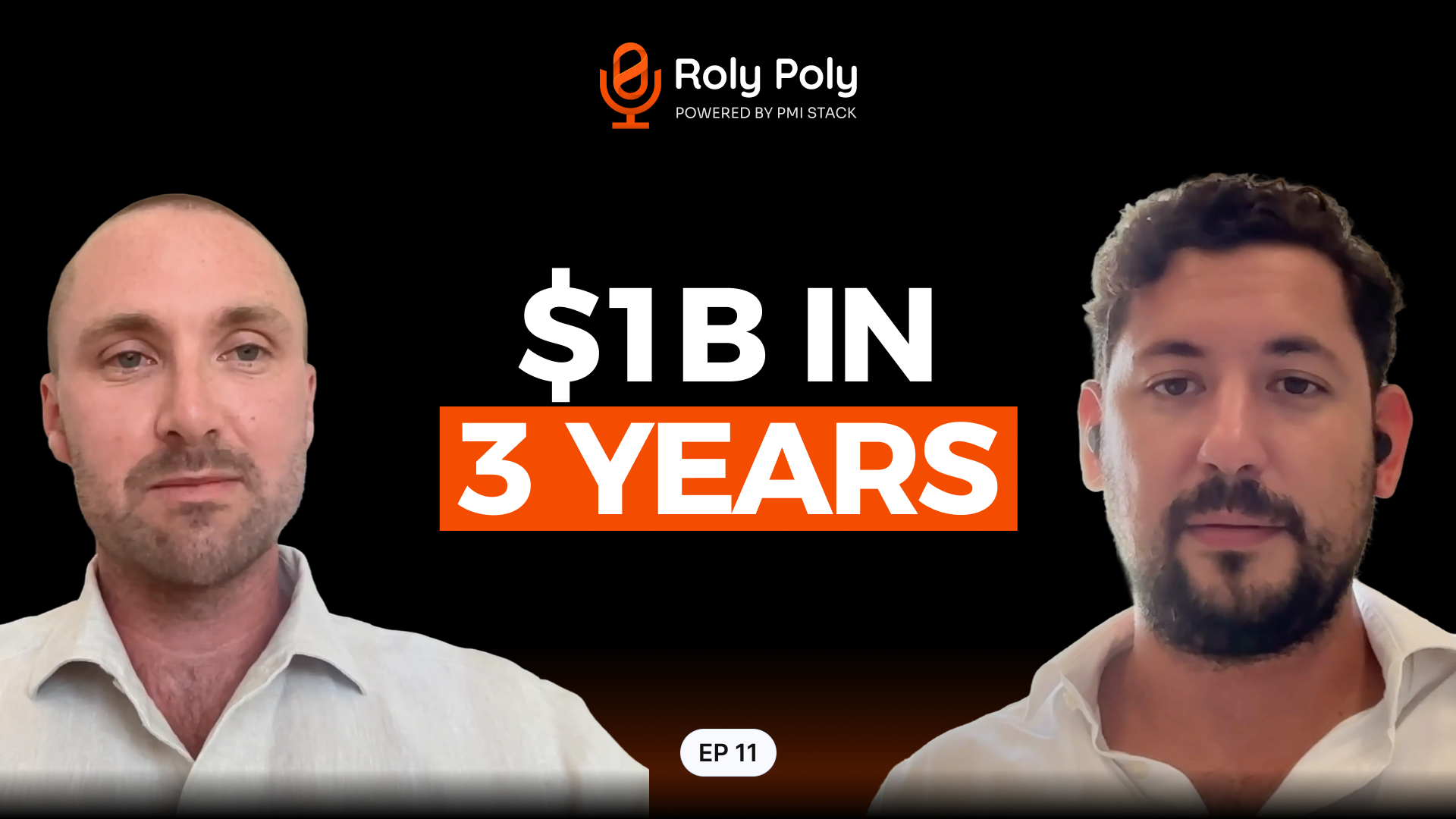
This article is based on my conversation with Sam Turner, founder of Advantos Group, on the RolyPoly podcast.
When I started interviewing operators building roll-ups in the UK, I had a working hypothesis about integration: the more you decentralize, the better. Let acquired businesses keep their brands, their autonomy, their independence. That sounded elegant on a whiteboard.
Then I spent 90 minutes with Sam Turner - someone who's done corporate M&A at billion-euro scale (Hotelbeds), botched his first SME acquisition, and spent the last four years building Advantos, a £30M+ roll-up in mechanical & electrical (M&E) and facilities management. His journey proves something most textbooks get wrong: the integration question isn't about decentralization versus centralization. It's about matching your operating model to the fragility of small businesses.
What Sam learned, painfully, is that small businesses (£5M revenue) are fragile. One key person leaves and everything shakes. That fragility makes full decentralization risky. But premature integration destroys value and kills deal momentum. The answer - which took him three years to figure out - is a hybrid: hub-and-spoke, where the business P&L and brand stay local, but critical support functions centralize at group level.
This isn't theory. It's the difference between recovering from a near-death first acquisition and scaling to £30M. Here's what I learned from Sam's story.
The Hubris: "We'll Keep Everything Separate and They'll Collaborate Naturally"
Sam's original thesis made intuitive sense. He'd just come through a painful corporate integration at Hotelbeds, where they merged three £3B organizations. That was a sprawling nightmare of politics, misaligned incentives, and the painful gap between PowerPoint synergy models and on-the-ground reality.
So when he founded Advantos in December 2021, he thought: I'll reverse that. Complete decentralization. Each business runs its own P&L, keeps its own brand, operates autonomously. Collaboration will happen naturally.
It didn't.
"Herding cats" is how Sam describes it. Cross-selling traction? Yes, that worked - teams did find ways to bid on projects together. But best practice adoption failed. Getting five independent businesses to standardize on the same tech platform, the same CRM, the same health & safety protocols? Impossible. Everyone defended their own patch.
And then AI became a priority. Sam wanted to deploy AI-enabled technology across the portfolio. But with five different finance systems, three different data structures, and no central authority to mandate standardization, it became "a nightmare," as he put it.
The lesson: Decentralization works for mature, resilient businesses with deep benches. It doesn't work for small businesses where one person leaving is a crisis.
The Fragility Problem: Why Small Businesses Break When You Leave Them Alone
This is the insight Sam had around year two, and it changed everything.
"The fragility of a small business is quite high," he told me. "One person leaves and it's a drama."
That's not weakness - it's just the reality of a £3-5M business. There's no redundancy in leadership. No bench. If your finance person quits, you don't have four other accountants picking up the work. You have... nobody. Same with your top engineer, your operations manager, your biggest client relationship.
In a mature business, one departure is managed. In a small business, one departure can spiral. It destabilizes the team, spooks clients, and forces you to make bad short-term decisions to stabilize cash.
Sam realized: If I keep these businesses completely decentralized, I'm betting the entire acquisition on the continuation of key individuals. That's not investing. That's hosting. If something happens to the MD, the business goes sideways. If a critical engineer gets sick, operations suffer. If a major contract ends, nobody has been trained as a backup.
The insight that changed his model: centralize the support functions where fragility lives. Build redundancy at group level.
So he moved from "completely separate" to what he calls hub-and-spoke:
- Stays local: P&L ownership, brand, core operations, customer relationships
- Moves to group (hub): Finance, HR, quality/health & safety, marketing, admin support, technology infrastructure, sales strategy
Why this works: Instead of five finance people scattered across five locations doing the same work inefficiently, you have one team of 15-20 supporting all five. One person's absence doesn't tank the business. Best practice adoption becomes possible. Technology deployment becomes fast instead of "a nightmare."
From PowerPoint to Reality: The Integration Planning Fallacy
Before we go deeper into what actually works, let me address something Sam said that hit me hard:
"Nobody pays attention to the dissynergies in a deal. PowerPoint shows upside on upside on upside. But that's not reality."
This is exactly the problem with traditional integration playbooks. They build models in Excel showing 20% cost savings, 15% revenue upside, and 10% EBITDA margin expansion. All upside. All contingent on assumptions nobody validates with the people who have to execute them.
Then you close the deal, hand people a plan they didn't help design, and watch buy-in collapse.
Sam learned this at Hotelbeds during the GTA + Tourico integration. The central team (McKinsey was involved, he mentioned) modeled out detailed synergies. But the people closest to the work - the MDs who had to deliver it - had no input on the plan. They were defending their turf, protecting their teams, and resisting something they had no ownership of.
The consequence: accountability without autonomy. Sam was being held to P&L targets on a plan he didn't help design. It's a recipe for cynicism, not execution.
When you design a roll-up integration strategy, this matters enormously. If your acquired business leaders aren't involved in designing the integration, they're already halfway checked out.
The First Acquisition Disaster: What Not to Do
Let me walk through what went wrong with Advantos's first deal, because it's a masterclass in risk blindness.
The business: A plumbing & heating installation contractor. Fixed-price, multi-year contracts with residential developers. Revenue looked predictable - they had 2-3 year contracts locked in, so "the next 12 months was pretty much certain from a revenue point of view."
The risk nobody saw coming: Inflation.
"I failed to really understand what happens if costs start to go up," Sam said. "You've got a contract with a fixed price with a customer."
Then, literally after closing, inflation went from near-zero to 20-40% on materials. Materials were the biggest cost component. The business was already low-margin. The combination of cost inflation and a housing market downturn (interest rates spiked, developer demand collapsed) was what Sam calls "a perfect storm."
The business went from £5M revenue to essentially zero within 18 months. It lost money from day one.
The human failures:
- Sam met the seller only twice, both times toward the end. The first was in person just two weeks before closing. Most of the process was done on calls from Switzerland.
- He didn't do proper due diligence on people, systems, and culture. There was "poor management quality," no real systems (mostly Excel), and a non-team-oriented culture.
- The seller set up in competition literally two weeks after Sam paid the final deferred payment, poaching management and engineers. The contract lacked adequate non-compete protections.
The lesson Sam would give himself: "I paid the price of being too eager to get the first deal done. Not doing the diligence around the people in the business and the culture and the management quality."
This is the vulnerability in financial due diligence: you can model cash flows, you can verify contracts, but you can't fully audit a person's integrity or a management team's competence in a few calls and meetings. You can create signals though - spend time with the team, talk to people outside the seller's earshot, ask what happens when things break, stress-test the most optimistic assumptions.
Sam now does multiple rounds of reference calls, involves his board advisors in interviews, uses profiling tools to understand candidate energy and preferences, and asks deeper questions about industry risks, not just upside scenarios.
But the real cost of the first acquisition wasn't just the loss. It was the distraction. While that business was burning, Sam had already closed deals two and three (July/August 2022). He had to keep operating the portfolio while managing a drowning business. For a scrappy founder, that's brutal.
The Recovery: Why People Are the Difference Between Win and Lose
The painful irony: the business that went to zero had one important consequence. It forced Sam to build a better operating team.
When he brought in his COO - "a superstar hire" from his network, with deep M&E background and experience scaling from zero to 50 engineers at a previous company - everything shifted.
"That hire was game-changing," Sam said.
The COO proposed a pivot: instead of trying to save the failing construction division, spin up an entirely new FM (facilities management) business inside the struggling portfolio. Use the same entity, but different business model.
Here's what happened:
- Year 1 (July 2024 - June 2025): £4M revenue, £500K EBITDA
- Year 2 (projected): £9M revenue, £1.2M EBITDA
Created from scratch. Inside a failing portfolio. In 18 months.
This isn't luck. This is what happens when you have the right person leading.
"Everything is about people at the end of the day," Sam said. "If you have the right people around you, you'll succeed. If you don't, you won't succeed. It's as simple as that."
This principle extends through the whole business:
- Finding leaders: Sam uses a rigorous process. He leans on trusted networks (board advisors, his COO). He gets multiple people to interview candidates - all group executives, board members, plus profiling tools. He sells the vision, not just the salary. Classic example: two CFO candidates. One was more like him (creative, visionary), one more traditionally "accounting-like." Sam was leaning toward the former because they "got on better." His board advisor pushed back, citing the profiling data: You need someone who complements you, not mirrors you. Sam went with candidate two. "That's been a fantastic hire."
- Measuring engagement: Most businesses track financials obsessively and ignore engagement. Sam does the opposite. He surveys teams every six months on a framework covering rewards, communication, recognition, teamwork, and growth. "The engagement of your people probably determines where your P&L trajectory is going in the medium term," he said. "Yet most people disregard those numbers because they think it's soft." It's not soft. It's leading.
- Retention through purpose: Sam built Advantos around a mission - "the UK's favorite platform for M&E and FM companies." That phrase matters. Favorite means something across four dimensions: to employees (great place to work in an industry not known for it), to customers (speed, expertise, technology, national coverage), to the community (social value and giving back), and to shareholders (the natural result of getting the other three right).
This isn't navel-gazing. It's how you retain the COO who could leave tomorrow with six months' notice and crater your FM business. You do it by working on something genuinely interesting, building alongside people who care, and being clear about where it's headed.
The Hub-and-Spoke Model: When to Integrate, How Quickly, and Where
By year three, Sam had written an actual integration playbook. He structured it around sequencing:
Month 1-2 focus on X. Month 3-4 focus on Y. But crucially: flexible depending on the acquisition.
The principle: "Focus on where the value is biggest."
If you're acquiring a business with great systems and processes, don't force them to change. Layer on cross-selling instead. If you're acquiring a business with poor finance infrastructure, that's month one.
The bigger question: when do you move from "hands off" to "integrate"?
Sam's experience: Don't do it day one. "If we were to do it from day one, it's more painful." But don't wait five years either. He now brings new acquisitions into the hub-and-spoke model after 18-36 months of settling in.
The hub-and-spoke model itself covers:
At the hub (centralized):
- Finance & accounting
- HR & payroll
- Quality, health & safety protocols
- Marketing (brand & comms)
- Technology infrastructure & AI deployment
- Sales strategy (group-level opportunities)
- Administrative support
At the spoke (local):
- P&L ownership (MD is still accountable)
- Brand identity
- Day-to-day operations
- Customer relationships
- Local hiring
- Engineering/delivery team
Why this works:
- De-risks the business. If a key person leaves, there's redundancy. The business doesn't crater.
- Speeds execution. One person owns the AI deployment strategy instead of "trying to get 5 businesses to adopt it at the same time is a nightmare."
- Drives higher acquisition multiples. A business with built-in scale and recurring group services is worth more to a buyer than a scattered collection of independent operators.
- Preserves autonomy where it matters. The MD still owns the P&L. They're still incentivized to run a tight ship.
The 10-Year Lens: Why Short-Term Optimization Is a Trap
Sam takes a deliberately long-term view. Four years in, with a 10-year horizon, he's not optimizing for next quarter's profit. He's building something that compounds.
This shows up in how he runs the business:
- Reinvestment over dividends. Sam and his wife took zero salary for the first three years. Even now they pay themselves "way under market" to maximize reinvestment.
- Patience on acquisitions. He's done four in four years, then paused for two years to build systems and technology infrastructure. One-to-two per year is his sustainable pace.
- Avoiding institutional capital. Sam owns ~70% of Advantos. Multiple PE firms have approached. He's deliberately stayed independent (at least until reaching £5M EBITDA) because "the minute you take institutional capital, the game changes in terms of who you're working for." That independence is worth more to him than a quick growth injection.
- Building infrastructure that scales. The £9M FM business he built from scratch in 18 months only works because he's invested in group-level finance, technology, and operations. That leverage isn't available if you're fully decentralized.
His philosophy: "It's not making short-term decisions to improve profits tomorrow. It's about improving the medium to long-term sustainability and quality of the business."
That's the opposite of most roll-up playbooks, which are designed for 3-5 year PE exits. Sam is building for 10 years. It changes everything—from what you hire for, to how you integrate, to what you measure.
The PowerPoint vs. Reality Gap (And Why It Matters for Your Integration)
Let me bring this back to something Sam said that deserves its own section, because it's the root of most integration failures:
"Nobody pays attention to the dissynergies in a deal."
When you build an integration plan, you model synergies:
- Cost savings from consolidating finance teams
- Revenue upside from cross-selling
- Margin expansion from shared procurement
- Technology leverage from unified systems
All real, all possible. But you model them in a spreadsheet without asking: What breaks when we do this?
Sam calls this the "disconnect between PowerPoint and the field."
Examples of dissynergies (things that cost money when you integrate):
- Managers spending time in migration instead of running the business
- Duplicate systems during transition that cost twice as much
- Key people leaving because they don't like the new structure
- Customer confusion during branding/process changes
- Short-term revenue dips as teams adjust to new systems
Most integration plans don't budget for these. They assume 100% adoption of plans people didn't design and weren't asked to deliver. Sam saw this at corporate scale—thousands of people, McKinsey involvement, months of planning—and it still failed because people had no ownership.
In small business acquisitions, it's worse. There's less organizational depth, so disruption hits harder.
The practical fix: Build dissynergy scenarios into your integration plan. Ask: What's the worst realistic case? What would break? What do we need in reserve? Then involve the people who have to execute. Get buy-in on the plan, not just the outcomes.
This is exactly the kind of challenge we help operators navigate at PMI Stack—building repeatable integration processes and integration playbooks that account for both upside synergies and the realistic friction of bringing systems together. It's harder work than a spreadsheet, but it's the difference between integration that compounds value and integration that destroys it.
The Hiring Lesson: Data Beats Chemistry
Sam nearly made a hiring mistake on his CFO.
Two candidates. One was "more like me"—creative, visionary, entrepreneurial. One was more traditionally "accounting-like"—structured, systematic, risk-focused. Sam was naturally drawn to the first.
His board advisor challenged him: Look at the profiling data.
The profiling tool (measuring energy levels, task preferences, behavioral styles) made it crystal clear: candidate two was the right hire. Not because he was better overall, but because he complemented Sam's weaknesses instead of mirroring his strengths.
Result: "That's been a fantastic hire."
This matters because hiring is where operators get most wrong. You hire for culture fit (people like you). You hire for chemistry (you got on well in the interview). You hire for the resume (they've done the job before).
But the best hires are often the ones who complement you, not the ones who are most similar to you.
Sam now uses profiling tools as a regular part of hiring. He gets multiple people on the interview panel. He reads the data, not just the gut feeling.
Most roll-up operators don't do this. They hire the person they like best, wonder why the hire doesn't work out 18 months later, and repeat. Sam's willingness to override his instinct with data is part of why his executive team is performing.
What I'm Taking Away
Sam Turner's journey—from burning £5M on his first acquisition to building a £30M+ group with a healthy FM division—isn't typical. His first deal could have ended everything. The combination of market downturn, poor diligence, and the seller setting up in competition was brutal.
But the lessons are:
- Decentralization has limits. For small businesses, fragility is real. A truly decentralized model works only if you have deep organizational benches. You don't, usually.
- Hub-and-spoke beats both pure centralization and pure decentralization. Local P&L ownership keeps accountability and motivation high. Group-level support functions remove fragility, drive consistency, and enable faster execution.
- Integration timing matters more than integration speed. Don't force integration day one. Give the business 18-36 months to settle. Then move deliberately based on where value is biggest.
- People are the leading indicator. You can model cash flows, but you can't fully audit integrity. Create signals. Do multiple rounds of reference. Involve multiple people in hiring. Use data (profiling tools, 360 reviews) to complement your gut.
- PowerPoint and reality don't match. Budget for dissynergies, not just synergies. Get buy-in from people who have to execute, not just from deal people who model upside.
- Long-term ownership changes everything. If you own 70% and you're planning a 10-year hold, you make different decisions than if you're targeting a 5-year PE exit. Sam's willingness to invest in systems, avoid institutional capital, and build slowly explains why his recovery worked.
The roll-up model works. But it works because of execution, not because of the business plan. Sam's story—painful start, deliberate recovery, building the right team and structure—is what it actually looks like.
.png)