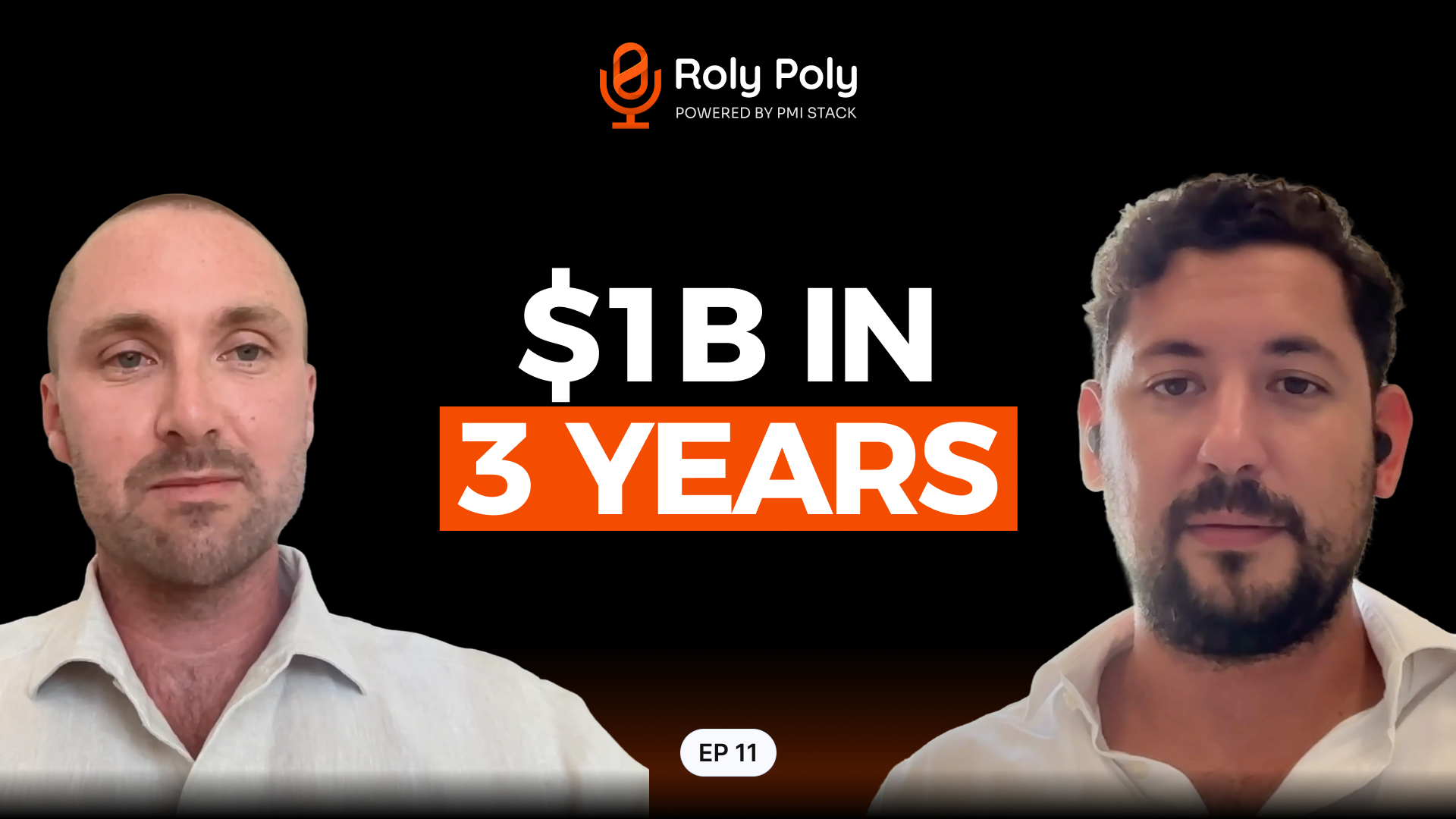
This article is based on my conversation with Mac Lackey, founder of Exit DNA and owner of Spanish football club Algeciras CF, on the RolyPoly podcast.
Most of the guests I've had on RolyPoly sit on the buy side. Deal sourcers, investors, operators building platforms, people whose entire mental model is how do I buy better? Mac Lackey is the first person I've spoken to who's spent his whole career on the other side of the table. He's sold six companies. Two of them were eight-figure exits in his twenties. He's been acquired by PE firms, strategics, and media giants, and he now runs Exit DNA, a program that helps founders get ready to sell well.
What makes Mac worth listening to isn't the highlight reel. It's that he's candid about the mistakes. He told me he left "millions of dollars on the table" on his very first exit, lost a fortune in the dot-com bust because the only thing he knew how to invest in was tech stocks, and watched one of his own companies hand a buyer a billion-dollar opportunity and then squander it. The man has been on both sides of nearly every exit mistake there is, and he's turned that into a framework.
The thread running through all of it is one idea: you should be exit ready whether or not you ever plan to sell. Not because selling is the goal, but because a business that's ready to be sold is simply a better business to own. Here's what I took from the conversation.
Deals Don't Fail on Price. They Fail on Integration.
I asked Mac the single biggest mistake acquirers make in the first 90 days after a deal closes. His answer cuts straight to what we obsess over at PMI Stack: "Intelligent buyers know that good deals succeed or fail on integration."
Every deal looks good on paper. Nobody signs a deal they think is a bad idea. So the gap between a deal that works and one that quietly disappoints almost always opens up after close, in the messy work of merging people, culture, processes, and systems.
Then Mac told me a story I haven't been able to stop thinking about. His first company was sold into a roll-up that went on to do 29 acquisitions and then went public. A lot of the founders being aggregated were like him: young, scrappy, finally cashing in after years of eating peanut butter sandwiches and underpaying themselves. The day the company IPO'd, every one of those founders hit their financial dreams at once. And the buyer had given them no reason to stay.
"The day the company went public, we had no reason to ever stay around anymore. They didn't create any sort of incentive for us to stay. They created a multi, multi billion dollar IPO opportunity and then just watched it all walk out the door."
Twenty-something founders left almost immediately, Mac among them. One of his peers from that group went on to co-found Wayfair. That's the talent that walked out because nobody designed an integration that kept it.
This mirrors what we see at PMI Stack constantly. Buyers spend months on financial due diligence and almost no time planning how the acquired team, systems, and data will actually come together. The deal model assumes the value is in the assets. The value is usually in the people and the operation, and both can evaporate in the first quarter if integration is an afterthought. Mac's framing is the cleanest version of this I've heard: integration of cultures, people, processes, and systems is where deals succeed or fail.
Be Irresistible to Buyers: Don't Be a Multiple
The most quotable thing Mac said was also, I think, the most strategically important. When I asked where the opportunities are, he reframed the whole question around what makes a company worth buying in the first place:
"You have to be irresistible to buyers because you unlock something for them that's powerful. If you are just an EBITDA multiple, that's not powerful. It's just numbers."
This is the difference between selling a business and selling strategic value. If all a buyer sees is a cash-flow stream they can apply a multiple to, you're a commodity and you'll be priced like one. The premiums show up when you unlock something the acquirer can't easily build themselves: a brand, a technology, a customer base, or, increasingly, a team that's already solving their problem.
Mac pointed out that a lot of the AI acquisitions happening right now are almost entirely about people. "If that team is working on my problems, I'm winning." Big companies aren't buying products, they're buying speed into a market. A buyer pays a premium when acquiring you gets them somewhere bigger, faster, or cheaper than building it would.
The practical takeaway for any founder: stop thinking about what your business is worth and start thinking about what it would unlock for a specific buyer. That's the lever that moves valuation, and it's almost entirely within your control.
Always Be Exit Ready: Even If You Never Sell
If Mac could put one message on a billboard for every founder, this would be it. He doesn't care whether you plan to sell in three years, ten years, or never. You are in a dramatically better position if you're exit ready.
His reasoning is partly about timing and partly about agility. Mac walked me through the five factors he thinks about for exit timing: personal situation, macroeconomics, the IPO market, your industry's cycle, and the company itself. The one he says founders most overlook is the industry cycle. Industries move through expansion and consolidation, and if you miss the consolidation window, it might not reappear for five years or more. One of his companies sold during exactly such a window: competitors were raising tens of millions, multi-billion-dollar players were moving in, and Mac decided that if they didn't sell now, they'd be waiting half a decade.
He's blunt about his own bias here. "I probably have exited some of my companies early simply because I never wanted to be one second late. I'm okay to be early. I definitely don't want to be late." That lines up almost word for word with something Vadim Rogovskiy told me in an earlier episode, that you never really sell too early, you only sell too late. Mac and Vadim approached the table from opposite directions and landed in the same place.
What makes this urgent is volatility. Mac said that after 30 years, he's stopped thinking of black swan events as rare:
"I feel like there's a black swan event every year. It just depends on which industry it affects. Tariffs, gas prices, global pandemics, wars. Certain industries go from great to horrible overnight."
If you're exit ready, you can move when the market shifts. You can sell "while it's still very obvious to you, but not obvious to the world." If you're not, the window closes before you can get your house in order. Being exit ready (clean financials, documented processes, ready for due diligence) isn't an exit task. It's a resilience strategy.
The Founder's Paradox and the 4:45 Alarm
Nothing kills a valuation faster than a business that can't run without its founder. Mac calls it the founder's paradox: "The more valuable you are to the business, the less valuable the business is." It feels great to be in every meeting, closing every deal, making every call. But that feeling is the thing buyers run away from. Nobody wants to acquire a company where the founder is in the critical path.
I'll admit this one landed personally. I've been working to get myself out of the critical path of my own agency by placing a CEO, so I pushed Mac on what he actually tells founders to do about it. His answer was that step one is a decision: you have to be genuinely willing and able to step out. Most founders fail here because they don't believe the business can survive without them, or they just aren't willing to let go.
Once you've made that decision, he's a big believer in forcing functions. He told a story about when his first daughter was born and he committed to being home for dinner at 5pm every night, while running a 24-hour company. He set an alarm in the office for 4:45.
"I was literally standing up in front of my company at the whiteboard doing a presentation and the alarm went off. And I dropped the dry erase pen and I turned around and walked out of the office."
The first few days, his team assumed he'd come right back. But within about three days the conversation shifted: who runs the meeting when Mac's not here? Who takes the customer call at six? By forcing his own absence, he forced his team to build the systems and step into the gaps. The business got more valuable precisely because he made himself less essential.
The version of this I'd add for any operator: take a genuine two-to-three week holiday once a year and watch what breaks. Even if you never sell, it's basic risk management. If you get sick or have to step away, you don't want the whole thing to collapse.
AI Is the Early Internet: Get Neck Deep
Mac started his first real company in 1995, right after Netscape launched the commercial browser, when nearly everyone, including his own mentor, told him the internet was a fad. He sees AI exactly the same way now, and his advice on how to play it is refreshingly anti-analysis:
"If you're in the AI space, you're committed to building a company or a career or your personal life with AI and you're neck deep in it, it's almost impossible that you're not gonna win by being early and deep."
The mistake he sees founders making is the same one I see in the startup world: people feel they need the perfect idea, the perfect data, total clarity, before they act. Mac thinks that's the fatal flaw. You don't need to know exactly what AI will become. You need general conviction and a willingness to take action while you're early. Proximity compounds. This is the same structural bet Sam Hields made the venture case for in a previous episode, that the real prize in AI is the services economy sitting under the software layer.
Then the conversation got uncomfortably real. I run a web design and development agency, and I asked Mac, somewhat selfishly, whether I should sell at an okay valuation now or pivot it into something AI-native. He didn't soften it. He told me he'd recently built a landing page in Perplexity in under ten minutes: uploaded an AI-generated logo, gave it parameters, and got something "ninety percent as good as I would have gotten from any designer" who'd have charged thousands and taken weeks.
"To me, that was like, yeah, that industry's dead."
His broader warning was for any agency or finance firm owner: right now you can still sell to a big buyer who wants your small innovative team or software. In a year or two, those buyers will simply say "AI does that," and the business is worth zero. So the decision is binary: sell while there's still strategic value, or commit to a genuine top-to-bottom pivot (not "more AI-enabled," but actually an AI firm). What you can't do is sit still, because the value inches down every day you wait.
What Operators Should Actually Do
Strip away the stories and Mac's worldview comes down to a handful of moves any founder can start on this quarter:
- Treat exit readiness as operational hygiene, not an exit task. Clean financials, documented processes, due-diligence readiness. It makes the business better to own and lets you move when a window opens.
- Get out of the critical path on purpose. Use forcing functions (the scheduled absence, the hard 5pm stop, the three-week holiday) to force your team to build systems around your gaps.
- Sell strategic value, not a multiple. Know exactly what your business would unlock for a specific buyer, and build toward making yourself irresistible rather than just profitable.
- Watch your industry's cycle, not just your P&L. Consolidation windows open and close. Being ready means you can exit while it's obvious to you and not yet obvious to the market.
- Get neck deep in AI now. You don't need the perfect idea. You need to be early, deep, willing to act, and honest about whether your industry is one AI is about to eat.
The line I keep coming back to is Mac's framing that the option to exit is the point, not the exit itself. As he put it, if you're set up and ready and buyers want to pay maximum value, "you just have a better business. You get to choose." That's true whether you sell next year or never. Choice is the prize.
.png)