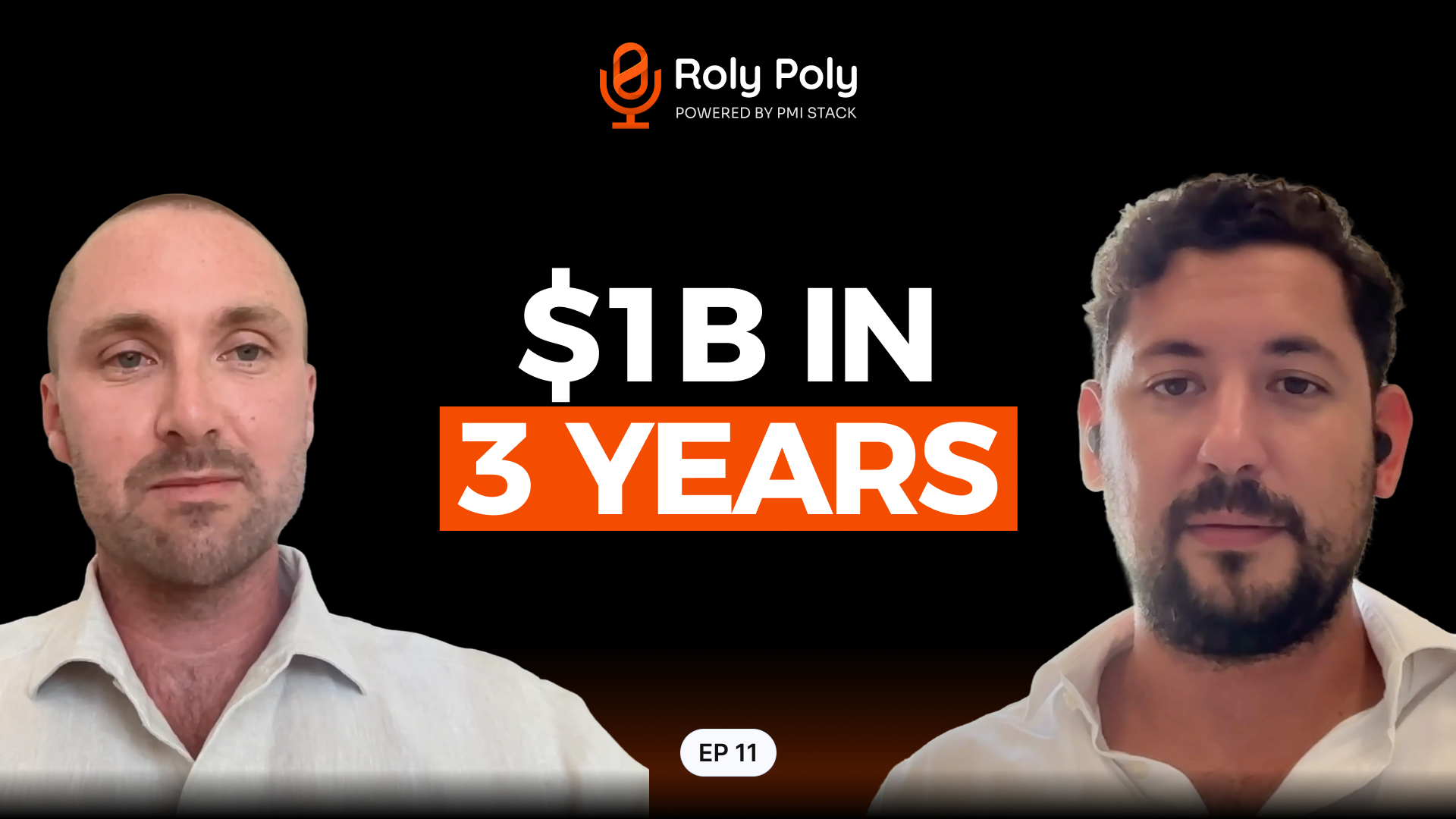
This article is based on my conversation with Alex Prokofjev, co-founder of Roll Up Europe, on the RolyPoly podcast.
At the end of every RolyPoly episode I ask the guest who else should come on. More than half of them named Alex Prokofjev. So this one was overdue.
Alex is 40, originally from Latvia, now based in Switzerland. He spent 15 years in M&A as an investment banker by training before stumbling into the lower mid-market via a small software roll-up his brother pointed him at. Three years ago he set up Roll Up Europe with his wife and brother, and it's now three businesses in one: the media arm (newsletter, conferences, bootcamp), a vendor arm, and an investing arm that backs holdcos and roll-ups directly. He also runs his own holdco in the Baltics, and did corporate development at Bolt and CFO work scaling Threecolts along the way.
What makes him useful is the vantage point. Most guests describe one seat. Alex sits above a few hundred of them and reads the pattern, and the pattern isn't the one most aspiring acquirers are working from. The structure question that consumes everyone, search fund or holdco or independent sponsor, is the wrong place to start. Here's what I took from the conversation.
The Small End of the Market Is Harder, Not Easier
The first thing Alex flagged is the assumption that trips up almost everyone arriving from a larger institution: that small deals are simpler versions of big deals.
They aren't. In a large process the propensity to transact is a given. A €100m EBITDA business comes to market via an advisor, everyone has known about it for years, and the parties can hurl insults across the table all they like, because at the end of it a deal is going to happen. It's a game with agreed rules.
Go and roll up small HVAC businesses or accountancy practices and none of that holds. As Alex put it, people do not know about your pedigree, and they do not care about your pedigree. The Stanford MBA and the years at a name-brand firm buy you nothing with an owner who has lived one industry for a generation, sometimes literally. It's a communication problem before it's a deal problem: people who are excellent at pitching institutional investors and advisors often struggle badly to build rapport with the person actually selling, and most serial acquirers are forced to rewrite their playbook at this point. (Andrea Allegrini described the same collision from inside an HVAC acquisition strategy.)
Start With Your Objectives, Not the Structure
This is the part I'd push anyone thinking about this to sit with.
The reason the structure question is so confusing is that the structures were designed by investors, for investors. Buy-and-build, independent sponsor, search fund, holdco: it's jargon built around how capital wants to be deployed, and if you haven't worked in private equity there's no reason it should mean anything to you.
So Alex's advice is to invert it. Write down your own objectives first, then let the structure fall out of them. He offered four tests:
Operator or allocator? An independent sponsor is effectively a fundless fund: you pull together capital and develop the platform, but somebody else runs it day to day, and the expectation is you'll build several. Alex is clear he's an allocator. He couldn't sit in a search fund running one business day to day. That's a temperament question, not a strategy question.
What's your time frame? Holdcos have exploded in popularity on the back of the succession wave, but they carry a J-curve. If you don't have ten-plus years to give, don't build one.
How much autonomy do you need? One committed capital source means you never worry about raising again, and you live under that investor's control. A consortium, search-fund style, or a VC round buys independence at the cost of permanent fundraising.
What do you actually want out of it? Financially, intellectually, is there a number? Start there, and the structures that fit reveal themselves.
One caveat on that first test: Alex reckons roughly 30% of the people he meets want to be allocators and maybe 5% realistically can be at the outset, because without an investment background it's very hard to raise for an allocator strategy. Investors want to see someone who has done it and built teams before. The usual path is to run one platform properly, learn how it works, then replicate. Allocator is a destination, not an entry point. (If you want the structural definitions themselves, I've written up how a roll-up differs from a buy-and-build separately.)
The Right Time to Talk to Investors Is Now
I asked when you should start talking to capital, expecting a “once you've got a credible thesis” answer. I got the opposite.
If you're serious and you're a high-conviction person, the answer is now. Alex sees enormous anxiety among his readers about not having the perfect thesis, about wasting a first impression. His reframe: the anxiety is exactly the same on the other side of the table. Investors are anxious to meet you. They want to help you arrive at a thesis.
The reason is simple, and it's the line I keep coming back to: most investors underwrite the person, not the idea. Your idea might be wrong. But there may be a better one, or a team that needs a co-founder. If you're six to twelve months from spinning out of a PE firm or a corporate and you have a hypothesis you want to test, start now. The only way to burn the relationship is to keep feeding people obvious non-starters and wasting their time.
This lines up almost exactly with what Nicholas De Poorter told me about Strada backing teams rather than sourcing deals. If the capital is underwriting you, the clock on that relationship starts well before the clock on your thesis.
One related warning about the search fund world. Alex rates it as the most welcoming subset of the lower mid-market, culturally closer to venture than to private equity. But it has a ceiling: aggregate available investment gaps out fairly quickly, often around €20m of equity, and search fund investors aren't always keen on add-on capital for a highly acquisitive strategy. If you can already see the consolidation potential at the outset, don't limit your fundraising to that pool.
The Most Expensive Mistake Is Blaming the Founder for a Bad Industry
When I asked what separates the operators who do well from the ones who stall, Alex gave me the sharpest reframe of the episode.
There's a tendency, particularly among people arriving from professional services, to read weakness in a business as a characteristic of its founder rather than of its underlying economics. You look at an underperforming company and conclude the owner is dumb, or you don't like his style. The alternative explanation, the one that's usually correct, is that it's just a terrible industry, and you cannot change the industry.
That single misread is, in his view, the number one mistake in the space: throwing a lot of money at turnaround situations. Unless you are genuinely a turnaround expert who can step in and fix an operation, stay away. He pointed at the e-commerce roll-ups and the high-churn software roll-ups that have floundered as the evidence.
The second failure mode is milestone design. Investors and founders attach targets to revenue, profit, or capital deployed. Those are bad milestones, because revenue doesn't equal value and short-term profit doesn't either. Tie yourself to “four acquisitions and €X of revenue by year two” and you will eventually buy whatever is available.
And then there's the honest bit the loudest voices in this space won't say. Alex is blunt about the promoters selling the idea that buying a business is simple, no money down, become an owner. Buying a company is very difficult, and most businesses that are profitable and solid are also very difficult to operate, which is precisely why they're profitable and solid. Without an M&A cycle behind you, or someone beside you who has one, every company will look either terrifyingly risky or suspiciously attractive and you won't be able to tell which. Sam Turner made the same point from the operator's chair when he talked about resilience through the integration cycle.
So what's the tell that someone will be top tier? Conviction, and specifically motivation that comes from somewhere other than money. Alex is wary of people turning to this as a stopgap now PE and VC fundraising has gone quiet. The stories he writes about tend to involve someone with a genuine right to win, or something to prove. Paul Barry is his example: after years inside testing and inspection companies, Barry founded his own group in 2019 wanting something permanent, less integrated, and not beholden to a single PE firm. Seven years later it's a business of considerable scale. The financial outcome still matters enormously, because that's how you keep everyone around you motivated. But it can't be the whole reason. The lower mid-market is not where the easy money is.
Work Backwards From the Exit, and What You Actually Take Home
Alex's framework for thesis design is to start at the end and reverse into it.
Mid-cap and large-cap PE is an AUM game. Funds keep getting bigger, which mechanically limits how much they can spend on any single platform, and very few firms can sensibly write €10m or €20m to build something from scratch. So the play he sees gaining real traction is to find an industry with the characteristics PE wants (recurring income, mission-critical service or product) and build the platform they'll want to buy. Those vehicles start getting interesting at roughly €10m to €15m of EBITDA.
From there you reverse in. How many targets exist, and how many are actually actionable? What's the average revenue and EBITDA? What return will investors need, typically three to four times net for a buy-and-build? That tells you how many deals a year you need to process. The first year is usually slow, one or two acquisitions, then it accelerates. He sees three to six years between the first acquisition and the initial exit, with a warning for anyone modelling a clean three-year run: the new owner will often want you to stay on a couple more years, or roll a significant chunk of your equity, because they want the platform to keep building. Walking away at close is rarely the deal. (Mac Lackey's episode on getting a business exit-ready covers the seller's side of that.)
Then the question nobody asks directly, so I did: how much do you actually make?
His answer was refreshingly concrete. For a typical buy-and-build, the vast majority of exits land in the three to five times net range. Put €20m in, exit at €80m, take a quarter of that. He's also seen far more spectacular outcomes, French radiology and Swedish wholesale platforms where proceeds ran into the hundreds of millions and the founders took a very significant chunk. It can be life-changing.
The waterfall matters more than the headline, though. Investors take a preferred return first, one and a half, two, two and a half times depending on the deal, and below that you see nothing. Above it there's usually a ratchet, so your share grows in each bracket. Across the outcomes Alex has seen, the founding team ends up with roughly 20% to 30% of total equity proceeds. Skin in the game varies: in independent sponsor deals you're expected to contribute several percentage points, which on a €30m to €50m raise runs into low seven figures, while in most buy-and-builds and search funds it's largely symbolic, on the understanding you're taking a below-market salary at the start.
AI in Acquisitions: Two Case Studies and One Warning
Every conversation Alex has with a serial acquirer now revolves around AI, and he frames it through two opposite case studies.
Bending Spoons is the success, and almost the anti-roll-up. Where most roll-ups buy small, grow the assets and integrate lightly, it has gone after larger, declining companies, taken them private, cut headcount aggressively and rebuilt the stack. It IPO'd at a twenty-billion-plus valuation with the stock up 41% on day one.
Team Shares is the cautionary tale. The premise was to buy very small businesses, around half a million of EBITDA, and replace their tech stack with an internal product, insourcing the accountancy and banking spend to convert cost lines into revenue streams. It struggled for two reasons: they weren't selective enough, buying businesses without defensive characteristics, and in the US the financial software market is so competitive that it's very hard to argue anyone should use an in-house alternative.
He applies the same test to Dwelly, the UK lettings platform that raised around £70m building internal AI processes and is now unbundling that software to sell to others. Alex's question is the honest one: if the software is genuinely superior to what's on the market, why wouldn't the market buy it? That's the bar. (I dug into the venture-backed version of this thesis with Sam Hields on AI-native roll-ups, and with Vadim Rogovskiy on AI in post-merger integration.)
He is positive on where the real opportunity sits: white-collar industries with genuine productivity gaps, property management and accountancy among them, where a business running at a 10% margin could plausibly run at 30% to 40%. Pair that uplift with owners who actually want to leave, and the outcomes can be powerful for everyone.
But the warning he closed on is the one I'd pin above the desk of every VC-backed AI roll-up founder:
“Don't assume that no one else is using AI. Private equity firms will have vastly more firepower than you. You don't want to be in a shootout when your gun is jammed, you have no bullets, and the guys have a lot of bullets.”
Property management is his example. Don't assume the PE-backed incumbents don't already have their own software, or aren't already grinding margins up. If you burn most of your capital building product and then run out, they still have bullets. His practical advice before you decide an industry is ripe for AI disruption: go and ask the community what everyone else is already doing.
Teams Break More Deals Than Models Do
After the bad-industry mistake, Alex's next two failure modes are both about people: unproven teams, and mismatched expectations about exit or roles.
His analogy is that roll-ups are a bit like families. At 40, he notes, a lot of families come apart because people discover their approaches to raising children simply differ. Same mechanism. Many investors won't back solo founders because the risk is too concentrated, and with duos they don't want people who haven't known each other long enough, because integrating lots of small businesses is stressful and you find out fast whether your partner is built for it. The pattern he increasingly sees isn't people who work together day to day, but people reconnecting after five or ten years apart on the back of a prior relationship.
Complementary skills matter as much as tenure. In the European buy-and-builds delivering outsized returns, the founders tend to slot together: one a consummate deal maker who originates well, the other more thoughtful about operations. And if you plan to change the whole operating stack, that second person is not optional:
“It's great to have a good product. It's great to have AI, it's great to have software, but somebody needs to go out there and talk to the workers in the field and convince them to use this technology. And if you're not that person, if you're not able to talk to people without just shouting orders, you're not going to get it done.”
That's the sentence in this episode that maps most directly onto our work at PMI Stack. The technical half of a systems integration is rarely what kills it. Adoption is. You can consolidate the reporting stack perfectly and still have three depots quietly running the old spreadsheets because nobody credible went and stood in front of them. (Pavleta Pavlova and I got into that in her episode on financial integration.)
If you don't have a co-founder yet, Alex's routes are practical. Go to the events, and do the homework before you arrive. Work out who the best-performing companies in your target industry are and talk to the people inside them: they've seen the playbook up close but often don't benefit from the share price, so the seed you plant can land. And don't be precious about brokers. There's a visible disdain among people leaving prestige banks and PE firms for talking to small-cap brokers and accountants, which he thinks is a serious error. The brokers are the gatekeepers. Positioning yourself with them as a credible buyer is one of the highest-leverage things you can do. Proprietary sourcing is wonderful if you have five years. Most people don't. (Andrew Ofori and I went deeper on the proprietary side in his episode on deal sourcing.)
You Don't Need a Private Equity Background
I close every episode by asking for a popular opinion in the roll-up or PE world that the guest thinks is wrong. Alex had clearly thought about it.
The wrong opinion, he says, is that you need private equity experience to succeed at this.
His argument is that people generalise from one narrow subset of the industry: buy-and-builds, where you buy quickly, integrate to some degree, and know on day one who you're selling to. That subset genuinely does require M&A and investment expertise. But holding companies exist. Other forms exist. And a lot of what private equity teaches is actively unhelpful in them, because it's built around autonomy and decentralisation and giving people a lot of freedom, which is not what every model needs.
His conclusion, and the note I'd end on: so many capable people talk themselves out of pursuing a thesis purely because they lack a PE pedigree, and that's just wrong. You can be successful without it. Just make sure you find the right niche.
Which, neatly, brings the whole conversation back to where it started. Not “which structure should I pick,” but “what am I actually trying to build, and what am I actually good at.” Get that order right and the rest is downstream. If you're at the stage where the integration mechanics start to matter, that's what our serial acquisition integration playbook is for.